Qwen-VL: A Versatile Vision-Language Model for Understanding, Localization, Text Reading, and Beyond
Qwen Team, Alibaba Group
arXiv 2308.12966
QwenLM/Qwen-VL
 Qwen/Qwen-VL
Motivation
- Despite their powerful capabilities in text generation and following user’s intentions via instruction tuning, native LLMs lack the ability to handle multiple modalities (e.g., images, speech, and videos) -> LVLM
- Current open-source LVLMs lag far behind the proprietary models, primarily due to inadequate training and optimization. -> open-source
- The majority of open-source LVLMs are limited to coarse-grained perception, lacking the ability for fine-grained visual understanding such as obect grounding, OCR and text-oriented question answering. -> fine-grained perception
Contribution
Method
Architecture
Large Language Model (7.7B): Qwen-VL model is initialized with pre-trained weights from Qwen-7B.
Vision Encoder (1.9B): Qwen-VL model employs Vision Transformer (ViT) as visual encoder, initialized with pre-trained weights from Openclip’s ViT-bigG.
- fixed resolution during both training and inference
- stride of 14 is used for the ViT encoder
Vision-Language Adapter (0.08B): a single-layer cross-attention module initialized randomly, compressing the image tokens to a fixed length of 256. Considering the significance of positional information for fine-grained image comprehension, 2D absolute positional encodings are incorpporated into the cross-attention mechanism’s query-key pairs to mitigate the poential loss of positional details during compression.
Inputs & Outputs:
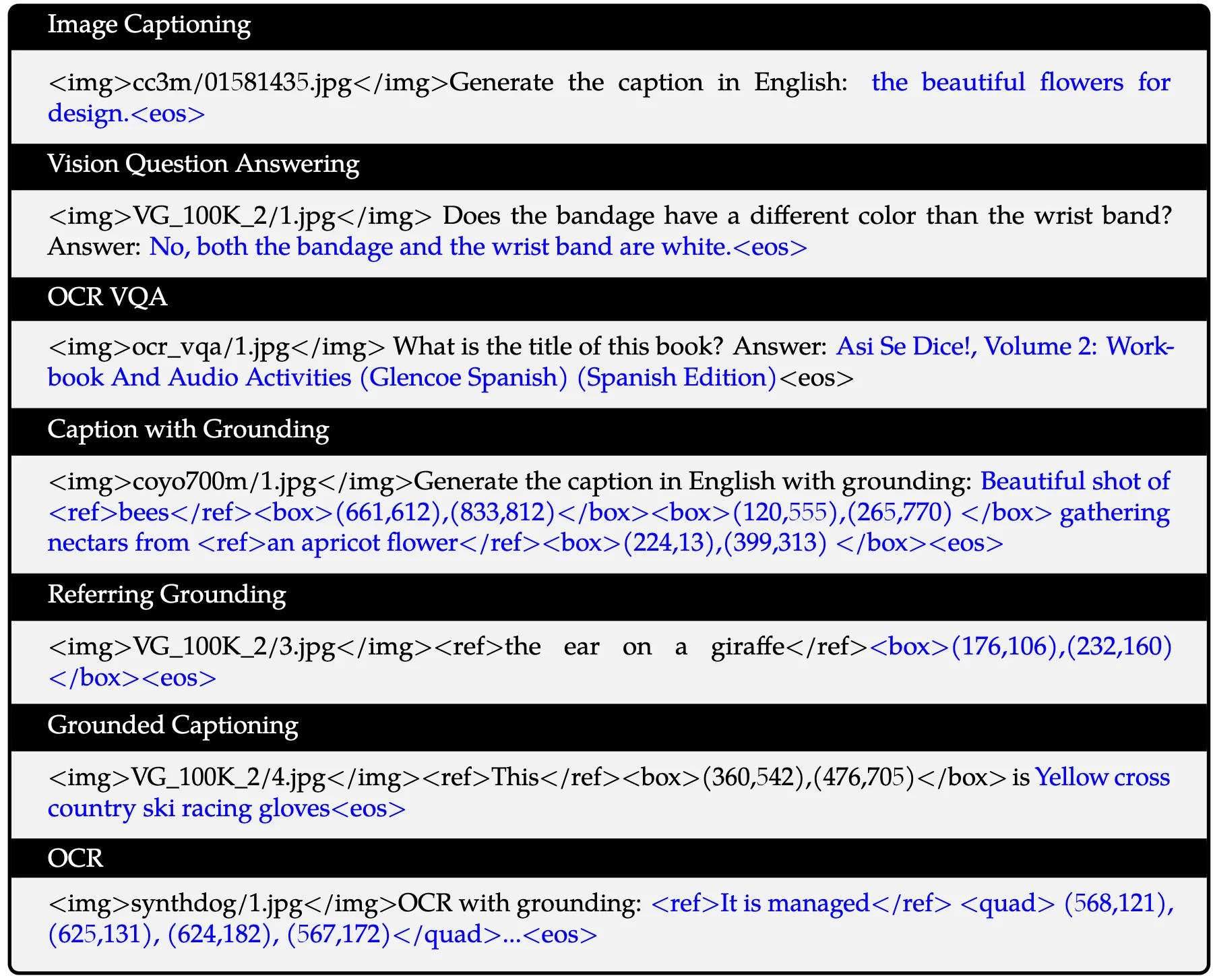
- Image Input: To distinguish visual input from text input, the image tokens is explicitly bracketed by two special tokens (
<img>and</img>), indicating the start and end of the visual input. - Bounding Box Input and Output
Visualization of the multi-task pre-training data format:
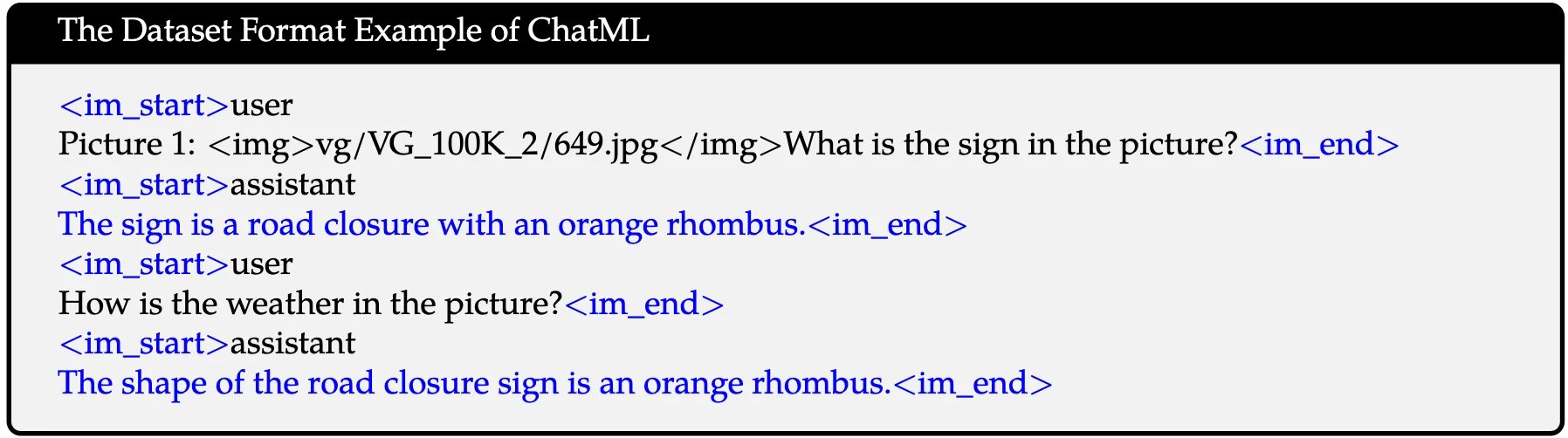
Visualization of the supervised fine-tuning data format:
Training Recipe
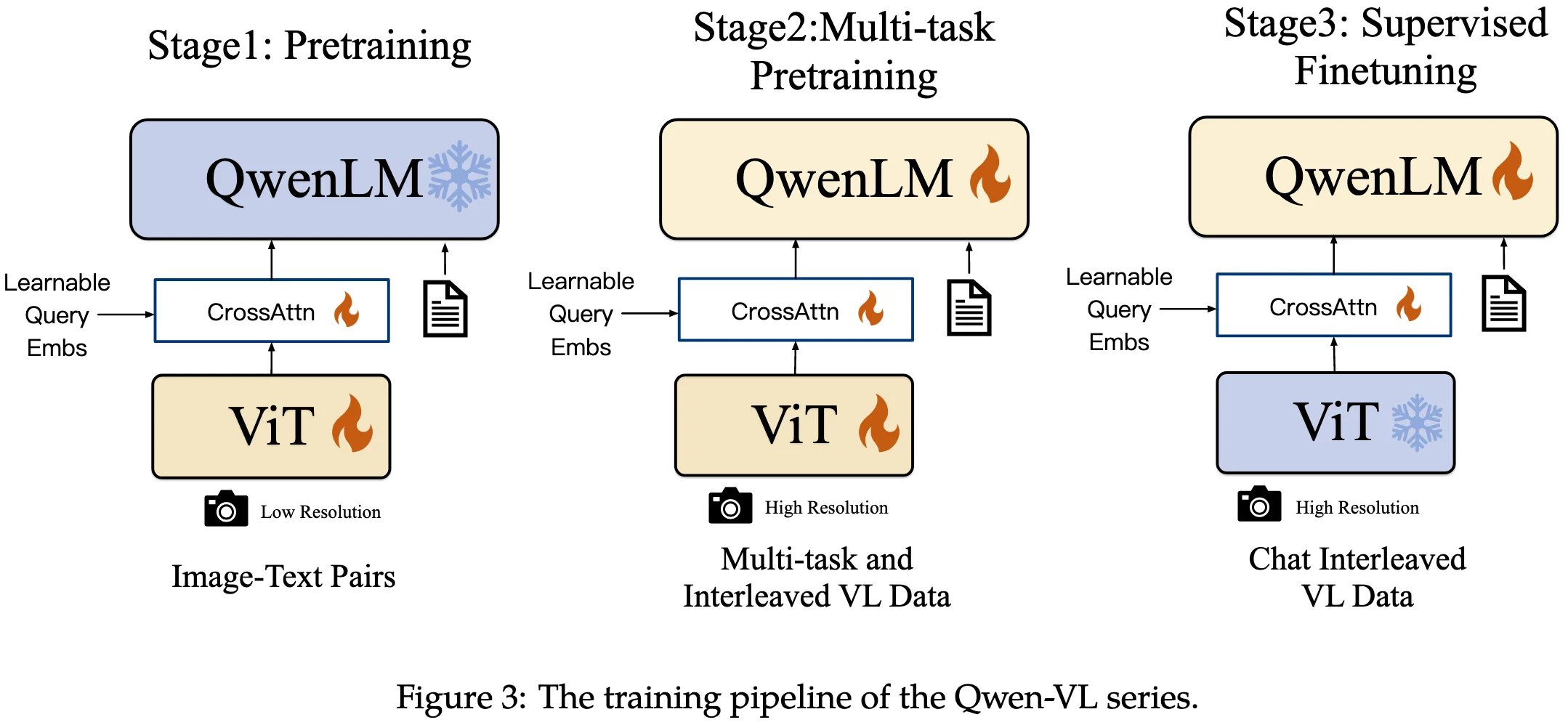
Pre-training
- In the first stage of pre-training, we mainly utilize a large-scale, weakly labeled, web-crawled set of image-text pairs, composed of several publicly accessible sources and some in-house data.
- freeze the large language model and only optimize the vision encoder and VL adapter in this stage.
- fixed resolution: 224x224
Multi-task Pre-training
- In the second stage of multi-task pre-training, we introduce high-quality and fine-grained VL annotation data with a larger input resolution and interleaved image-text data.
- unlock the large language model and train the whole model.
- fixed resolution: 448x448
Supervised Fine-tuning
- During this stage, we finetuned the Qwen-VL pre-trained model through instruction fine-tuning to enhance its instruction following and dialogue capabilities, resulting in the interactive Qwen-VL-Chat model.
Data Recipe
lots of data cleaning work!!! Please refer to the dataset details section!!!
Pre-training Data
In the first stage of pre-training, we mainly utilize a large-scale, weakly labeled, web-crawled set of image-text pairs, composed of several publicly accessible sources and some in-house data.
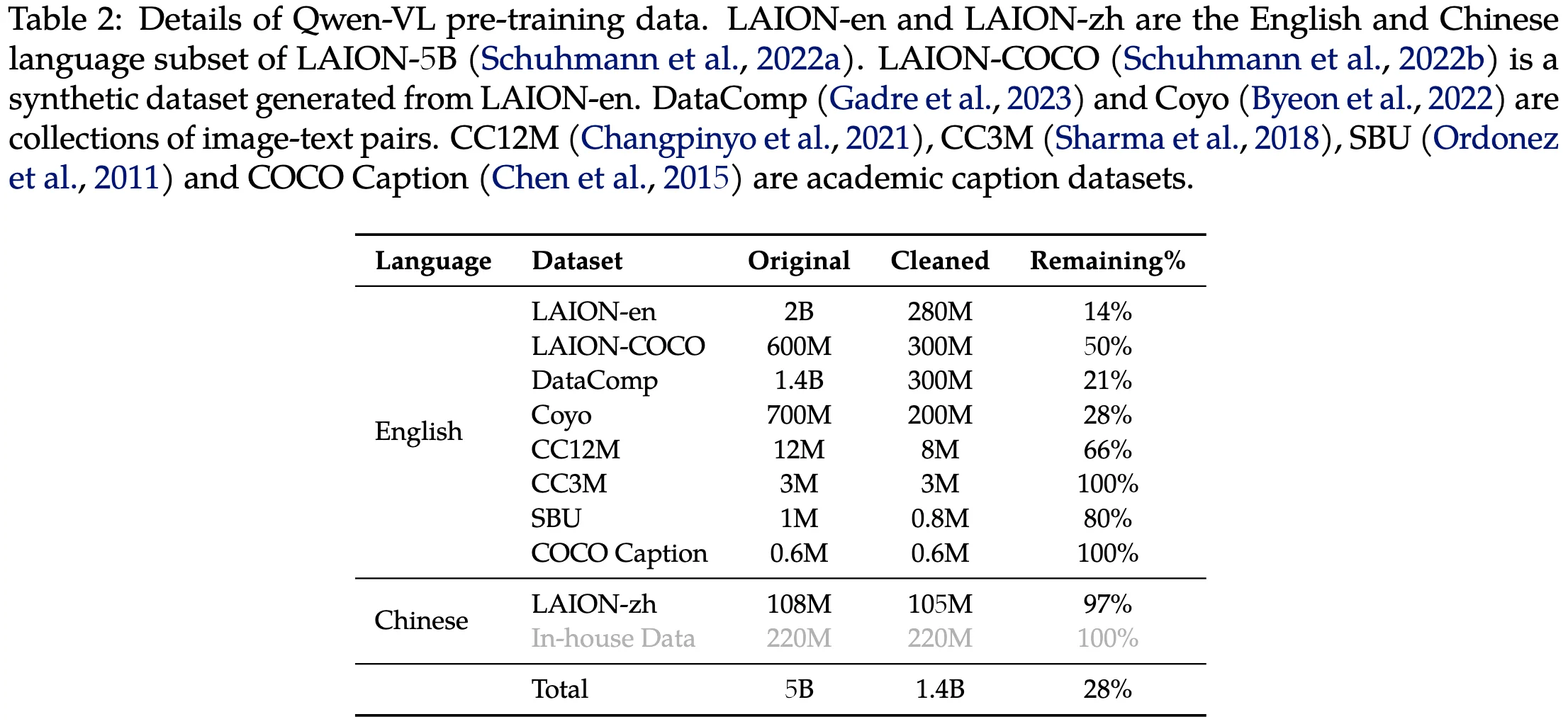
Multi-task Pre-training Data
In the second stage of multi-task pre-training, we introduce high-quality and fine-grained VL annotation data with a larger input resolution and interleaved image-text data.
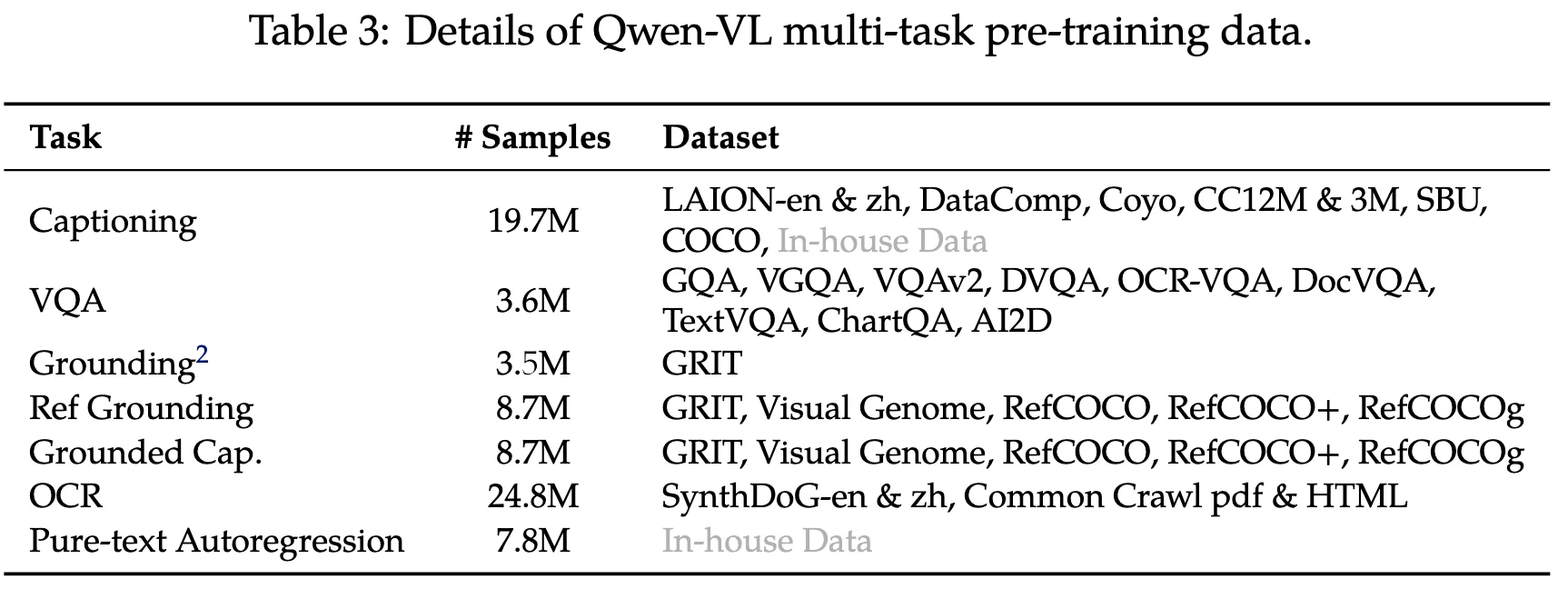
Finally, we simply construct interleaved image-text data by packing the same task data into sequences of <span style="color:red">length 2048.