SimLingo: Vision-Only Closed-Loop Autonomous Driving with Language-Action Alignment
Contents
Motivation
Contribution
Method
Task.
- Driving
- Vision-Language Understanding
- Commentary: describe the current decision and action in natural language.
- VQA: answer a question about the simulated driving scene.
- Action Dreaming (language-action alignment): a form of instruction following, to improve the alignment of language and action
Input.
- image
- navigational information:
- ego’s speed
- a task prompt with information about the current task
- Driving without language predictions: “Predict the waypoints”
- Commentary + Driving: “What should the ego do next?”
- VQA + Driving: “Q:
?>” - Action Dreaming: “
”
Output.
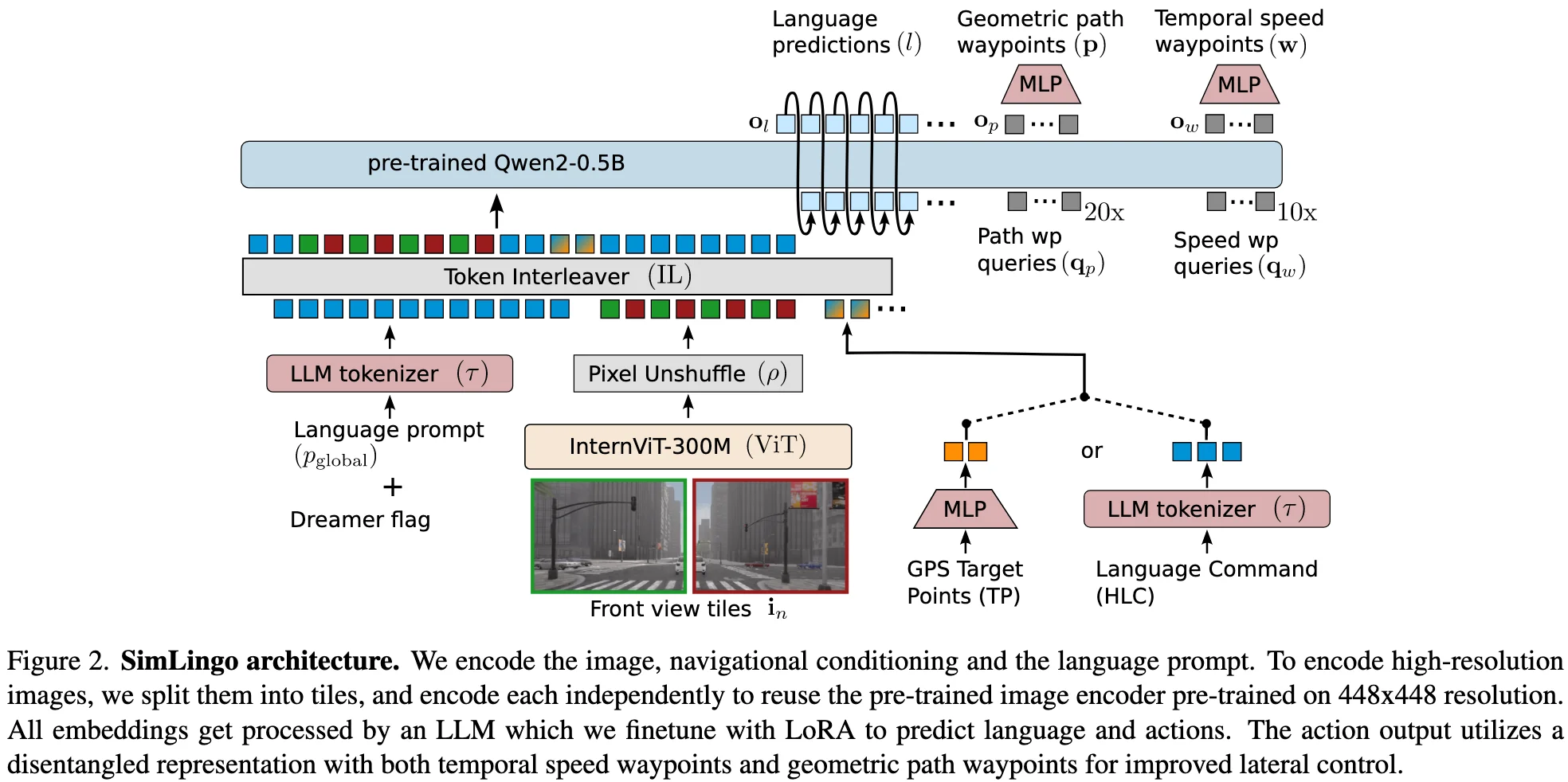
- action represention: a disentangled representation
- temporal speed waypoints -> target speed
- geometric path waypoints -> target angle
- language: auto-regressive token prediction
We noticed that:
- using only temporal waypoints for steering and speed led to steering problems, especially during turns or when swerving around obstacles.
- by using path waypoints, we achieve denser supervision.
- we also predict the path when the vehicle is stationary, leading to improved steering behavior.
Architecture. InternVL-2-1B.
- Vision Encoder (pretrained): InternViT-300M-448px (ViT)
- To be able to encode dynamic and higher resolutions, we split the input image into 448x448 pixel tiles and extract features for each tile independently.
- To reduce computational overhead due to the quadratic complexity of the LLM, we uses the pixel unshuffle technique to downsample the number of tokens by a factor of 4.
- LLM (pretrained): Qwen2-0.5B-Instruct
- Navigational information
- the next two GPS target points: encode with an MLP to obtain two navigational embeddings.
- or a high-level language command: use the standard LLM tokenizer to obtain the embeddings.
- during training, we randomly switch between the two input modalities.
- Speed v: use the speed v in natural language as part of the global LLM prompt.
- Navigational information
- Token Interleaver: replace the placeholder tokens with the corresponding embeddings.
Training.
- First, it auto-regressively generates the language predictions. (CE)
- Then in one additional forward pass, it generates the actions consisting of path and waypoints. (smooth-L1)
Inference. two PID controllers to get the steering angle and acceleration.
Experiments
Dataset
Benchmarks and Metrics
Leaderboard 2.0:
- Driving Score (DS)
- Route Completion (RC)
- Infraction Score (IS)
Bench2Drive
- driving score
- success rate
- efficiency
- comfortness
DriveLM-hard (VQA) and Commentary
- driving score
- success rate
- efficiency
- comfortness
Action Dreaming