NeurIPS 2017
Google
arXiv 1706.03762
tensorflow/tensor2tensor
TL;DR
Motivation
Contribution
Approach
Model Architecture

 1
 2
 3
 4
 5
 6
 7
 8
 9
10
11
12
13
14
15
16
17
18
19
20
21
22
23
24
25
26
27
28
29
30
31
| class Transformer(nn.Module):
def __init__(
self,
d_model: int = 512,
nhead: int = 8,
num_encoder_layers: int = 6,
num_decoder_layers: int = 6,
dim_feedforward: int = 2048,
dropout: float = 0.1,
) -> None:
super().__init__()
encoder_layer = nn.TransformerEncoderLayer(
d_model=d_model,
nhead=nhead,
dim_feedforward=dim_feedforward,
dropout=dropout,
)
self.encoder = nn.TransformerEncoder(encoder_layer, num_layers=num_encoder_layers)
decoder_layer = nn.TransformerDecoderLayer(
d_model=d_model,
nhead=nhead,
dim_feedforward=dim_feedforward,
dropout=dropout,
)
self.decoder = nn.TransformerDecoder(decoder_layer, num_layers=num_decoder_layers)
def forward(self, src: Tensor, tgt: Tensor) -> Tensor:
memory = self.encoder(src)
output = self.decoder(tgt, memory)
return output
|
 1
 2
 3
 4
 5
 6
 7
 8
 9
10
| class TransformerEncoder(nn.Module):
def __init__(self, encoder_layer: nn.TransformerEncoderLayer, num_layers: int):
super().__init__()
self.layers = ModuleList([copy.deepcopy(encoder_layer) for _ in range(num_layers)])
def forward(self, src: Tensor) -> Tensor:
output = src
for mod in self.layers:
output = mod(output)
return output
|
 1
 2
 3
 4
 5
 6
 7
 8
 9
10
11
12
13
14
15
16
17
18
19
20
21
22
23
24
25
26
27
28
29
| class TransformerEncoderLayer(nn.Module):
r"""TransformerEncoderLayer is made up of self-attn and feedforward network."""
def __init__(self, d_model: int, nhead: int, dim_feedforward: int, dropout: float):
super().__init__()
# Implementation of self-attention
self.self_attn = MultiheadAttention(d_model, nhead, dropout=dropout)
self.dropout1 = Dropout(dropout)
# Implementation of Feedforward model
self.linear1 = Linear(d_model, dim_feedforward)
self.activation = ReLU()
self.dropout = Dropout(dropout)
self.linear2 = Linear(dim_feedforward, d_model)
self.dropout2 = Dropout(dropout)
self.norm1 = LayerNorm(d_model)
self.norm2 = LayerNorm(d_model)
def forward(self, src: Tensor) -> Tensor:
x = src
x = self.norm1(x + self._sa_block(x))
x = self.norm2(x + self._ff_block(x))
return x
# self-attention block
def _sa_block(self, x: Tensor) -> Tensor:
x = self.self_attn(x, x, x)[0]
return self.dropout1(x)
|
Attention
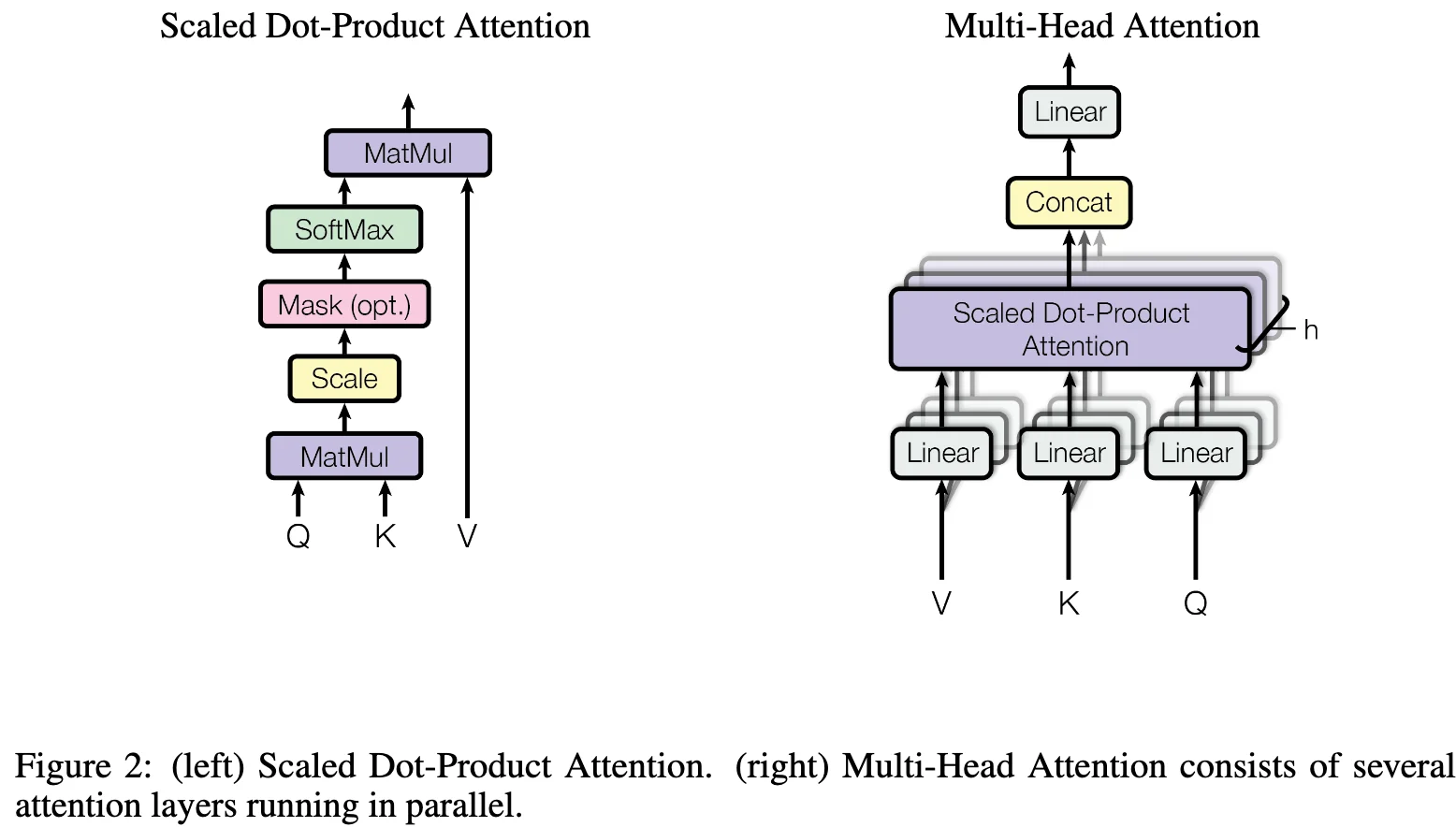
Scaled Dot-Product Attention
$$
\text{Attention}(Q, K, V) = \text{softmax}\left(\frac{QK^\top}{\sqrt{d_k}}\right)V
$$
where $Q \in \mathbb{R}^{n_q \times d_k}$, $K \in \mathbb{R}^{n_k \times d_k}$, $V \in \mathbb{R}^{n_k \times d_v}$, $n_q$ is the query sequence length, $n_k$ is the key/value sequence length, $d_k$ is the dimension of keys/queries, and $d_v$ is the dimension of values.
Why scale by $\sqrt{d_k}$? When $d_k$ is large, the dot product $QK^\top$ can have large magnitude, pushing the softmax into regions with extremely small gradients. Scaling by $\sqrt{d_k}$ prevents this by normalizing the variance of the dot products. Assuming $q_i$ and $k_i$ are independent random variables with mean 0 and variance 1, the dot product $q \cdot k = \sum_{i=1}^{d_k} q_i k_i$ has variance $d_k$, so dividing by $\sqrt{d_k}$ normalizes the variance to 1.
Common attention mechanisms:
1. Additive Attention (Bahdanau attention):
$$
\text{Attention}(Q, K, V) = \text{softmax}(v_a^\top \tanh(W_q Q^\top + W_k K^\top))V
$$
where $Q \in \mathbb{R}^{n_q \times d_k}$, $K \in \mathbb{R}^{n_k \times d_k}$, $W_q \in \mathbb{R}^{d_a \times d_k}$ and $W_k \in \mathbb{R}^{d_a \times d_k}$ are learnable weight matrices, $v_a \in \mathbb{R}^{d_a}$ is a learnable vector.
Dimension analysis with broadcasting: The addition $W_q Q^\top + W_k K^\top$ uses broadcasting mechanism to increase dimensionality:
- $W_q Q^\top: \mathbb{R}^{d_a \times d_k} \times \mathbb{R}^{d_k \times n_q} \rightarrow \mathbb{R}^{d_a \times n_q}$
- $W_k K^\top: \mathbb{R}^{d_a \times d_k} \times \mathbb{R}^{d_k \times n_k} \rightarrow \mathbb{R}^{d_a \times n_k}$
- Through broadcasting: $\mathbb{R}^{d_a \times n_q} + \mathbb{R}^{d_a \times n_k} \rightarrow \mathbb{R}^{d_a \times n_q \times n_k}$
The broadcasting expands both tensors to shape $(d_a, n_q, n_k)$, where each element $(i, j)$ corresponds to the attention score for query-key pair $(q_i, k_j)$: $\text{score}(q_i, k_j) = v_a^\top \tanh(W_q q_i + W_k k_j)$.
2. Dot-Product Attention:
$$
\text{Attention}(Q, K, V) = \text{softmax}(QK^\top)V
$$
Multi-Head Attention
 1
 2
 3
 4
 5
 6
 7
 8
 9
10
11
12
13
14
15
16
17
18
19
20
21
22
23
24
25
26
27
28
29
30
31
32
33
34
35
36
37
38
39
40
41
| class MultiheadAttention(nn.Module):
r"""Allows the model to jointly attend to information from different representation subspaces."""
def __init__(self, embed_dim: int, num_heads: int, dropout: float):
super().__init__()
self.embed_dim = embed_dim
self.num_heads = num_heads
self.dropout = dropout
self.head_dim = embed_dim // num_heads
self.scale = self.head_dim ** -0.5
self.qkv = Linear(embed_dim, embed_dim * 3)
self.out = Linear(embed_dim, embed_dim)
self.dropout = Dropout(dropout)
def forward(self, query: Tensor, key: Tensor, value: Tensor) -> Tensor:
qkv = self.qkv(query)
qkv = qkv.view(qkv.size(0), qkv.size(1), self.num_heads, 3 * self.head_dim)
qkv = qkv.permute(0, 2, 1, 3)
return qkv
q, k, v = qkv.chunk(3, dim=-1)
attn = (q @ k.transpose(-2, -1)) * self.scale
attn = attn.softmax(dim=-1)
attn = self.dropout(attn)
return self.out(attn @ v)
def multi_head_attention_forward(query: Tensor, key: Tensor, value: Tensor, embed_dim: int, num_heads: int, dropout: float) -> Tensor:
tgt_len, bsz, embed_dim = query.shape
src_len, _, _ = key.shape
head_dim = embed_dim // num_heads
# compute in-projection
# reshape q, k, v for multihead attention and make them batch first
q = query.view(tgt_len, bsz * num_heads, head_dim).transpose(0, 1)
k = key.view(src_len, bsz * num_heads, head_dim).transpose(0, 1)
v = value.view(src_len, bsz * num_heads, head_dim).transpose(0, 1)
# calculate attention and out projection
attn_weights = (q @ k.transpose(-2, -1)) * head_dim ** -0.5
attn_weights = attn_weights.softmax(dim=-1)
attn_weights = self.dropout(attn_weights)
return attn_weights @ v
|
Point-wise Feed-Forward Network
$$ \text{FFN}(x) = \text{Linear}(\text{ReLU}(\text{Linear}(x))) $$
1
2
3
4
| # feed forward block
def _ff_block(self, x: Tensor) -> Tensor:
x = self.linear2(self.dropout(self.activation(self.linear1(x)))) # [batch_size, seq_len, d_model]
return self.dropout2(x)
|
 1
 2
 3
 4
 5
 6
 7
 8
 9
10
11
12
13
14
15
16
17
18
19
20
21
22
23
24
25
26
27
28
29
30
31
32
33
34
35
36
37
38
39
40
41
42
43
44
45
46
47
|
class TransformerDecoder(nn.Module):
    def __init__(self, decoder_layer: nn.TransformerDecoderLayer, num_layers: int):
        super().__init__()
        self.layers = ModuleList([copy.deepcopy(decoder_layer) for _ in range(num_layers)])

    def forward(self, tgt: Tensor, memory: Tensor) -> Tensor:
        output = tgt
        for mod in self.layers:
            output = mod(output, memory)
        return output


class MultiheadAttention(nn.Module):
    def __init__(self, d_model: int, nhead: int, dropout: float):
        super().__init__()
        self.d_model = d_model
        self.nhead = nhead
        self.dropout = dropout
        self.head_dim = d_model // nhead
        self.scale = self.head_dim ** -0.5
        self.qkv = Linear(d_model, d_model * 3)
        self.out = Linear(d_model, d_model)
        self.dropout = Dropout(dropout)

    def forward(self, query: Tensor, key: Tensor, value: Tensor) -> Tensor:
        qkv = self.qkv(query)
        qkv = qkv.view(qkv.size(0), qkv.size(1), self.nhead, 3 * self.head_dim)
        qkv = qkv.permute(0, 2, 1, 3)
        return qkv

        q, k, v = qkv.chunk(3, dim=-1)
        attn = (q @ k.transpose(-2, -1)) * self.scale
        attn = attn.softmax(dim=-1)
        attn = self.dropout(attn)
        return self.out(attn @ v)

class TransformerDecoderLayer(nn.Module):
    def __init__(self, decoder_layer: nn.TransformerDecoderLayer):
        super().__init__()
        self.layer = decoder_layer

    def forward(self, tgt: Tensor, memory: Tensor) -> Tensor:
        return self.layer(tgt, memory)
|
def TransformerEncoder(x):
num_layers = 6
d_model = 512
nhead = 8
dim_feedforward = 2048
dropout = 0.1
transformer_encoder_layer = TransformerEncoderLayer(d_model, nhead, dim_feedforward, dropout)
for layer in range(num_layers):
x = transformer_encoder_layer(x)
1
2
3
4
5
6
|
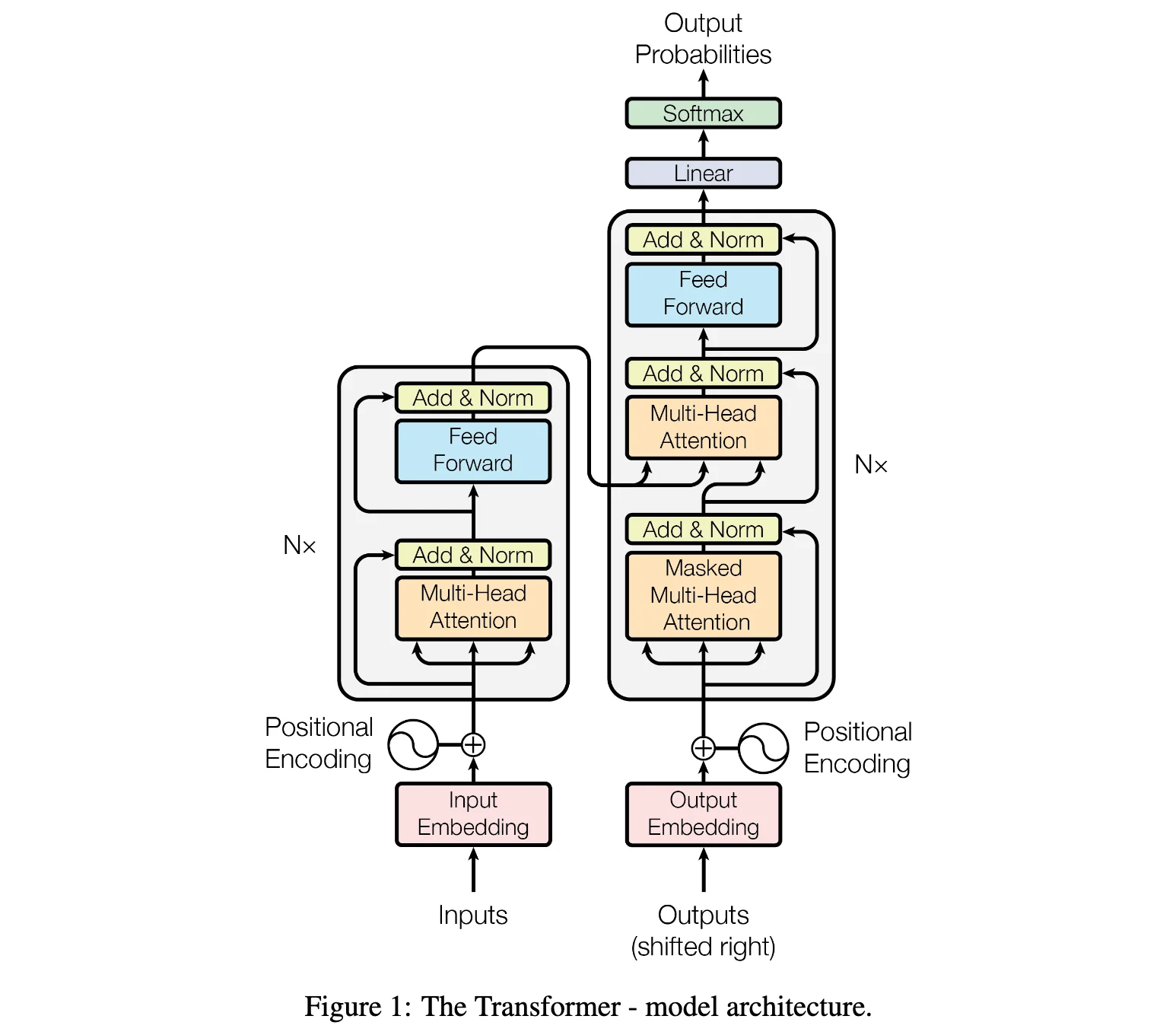
Transformer: A basic transformer layer.
```python
|
TransformerEncoder: a stack of N TransformerEncoderLayer.
TransformerDecoder: a stack of N TransformerDecoderLayer.
TransformerEncoderLayer: made up of self-attn and feedforward network.
https://docs.pytorch.org/docs/stable/generated/torch.nn.TransformerEncoderLayer.html
https://github.com/pytorch/pytorch/blob/v2.9.1/torch/nn/modules/transformer.py#L645
TransformerDecoderLayer: made up of self-attn, cross-attn and feedforward network.
 1
 2
 3
 4
 5
 6
 7
 8
 9
10
11
12
13
14
15
16
17
18
19
20
| # self-attention block
from torch.nn import MultiheadAttention, Dropout, Linear
self_attn = MultiheadAttention(d_model, nhead)
linear1 = Linear(d_model, dim_feedforward)
dropout = Dropout(dropout)
linear2 = Linear(dim_feedforward, d_model)
dropout1 = Dropout(dropout)
dropout2 = Dropout(dropout)
activation = ReLU()
def self_attention_block(x):
x = MultiheadAttention(query=x, key=x, value=x)
return Dropout(x)
# feed forward block
def feed_forward_block(x):
x = dropout2(linear2(dropout(activation(Linear(x)))))
return x
|
Experiments
References