GPT-2: Language Models are Unsupervised Multitask Learners
OpenAI pdf openai/gpt-2 Better Language Models and Their Implications GPT-2: 6-month follow-up GPT-2: 1.5B release
TL;DR
GPT-2 redefines language modeling as unsupervised multi-task learning, demonstrating that massive scaling enabling models to solve diverse downstream tasks in a zero-shot setting (without any parameter or architecture modification) through natural language prompts alone.
Motivations & Innovations
- Current systems are better characterized as narrow experts rather than general systems. -> unsupervised multi-task learning
- Despite the success of combining pre-training with supervised fine-tuning (SFT), SOTA language models still need task-specific SFT. -> zero-shot transfer
Approach
Language Modeling: Given an unsupervised corpus of tokens $U = \lbrace u_1, \ldots, u_n \rbrace$, we use a standard language modeling objective with a multi-layer Transformer decoder (decode-only) to maximize the following likelihood:
$$ L_1(U) = \sum_i \log P(u_i | u_{i-k}, \ldots, u_{i-1}; \Theta)$$
where:
- $k$ is the size of the context window
- $P$ is the conditional probability modeled using a neural network with parameters $\Theta$
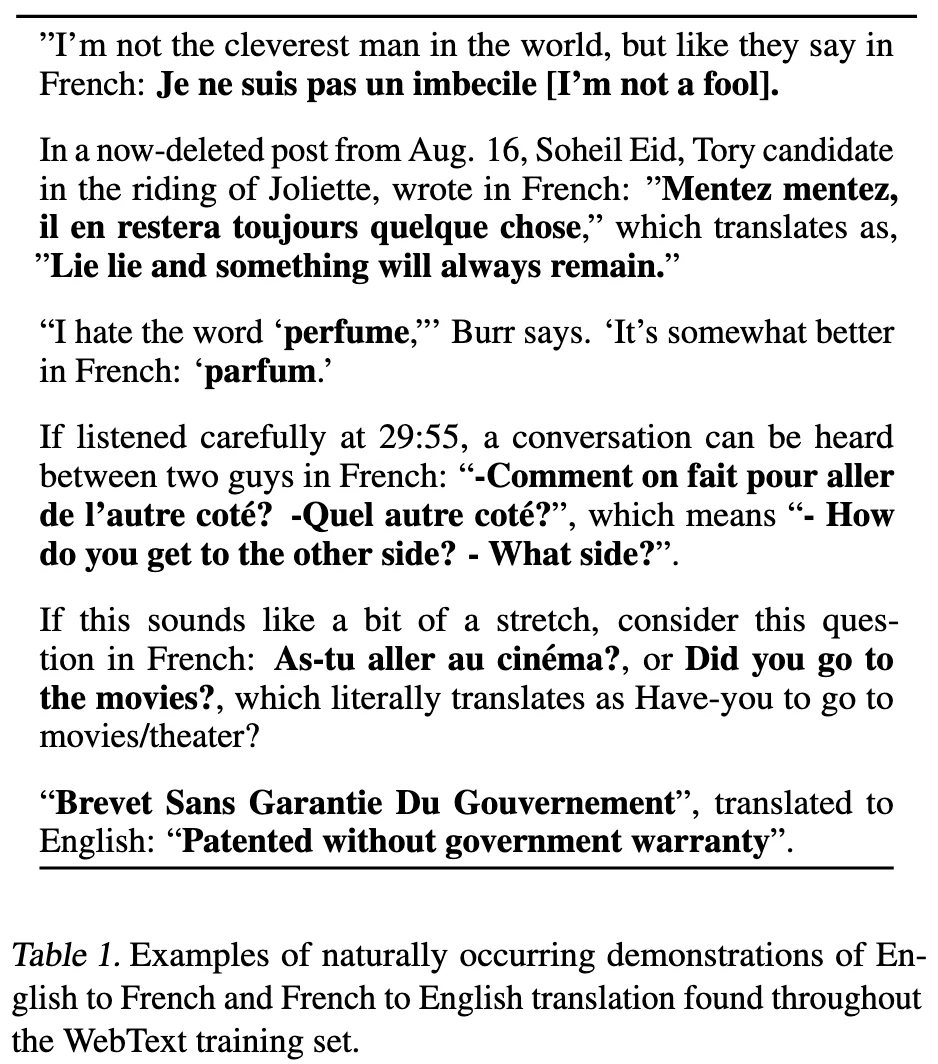
General Multi-task Conditioning via Unified Language Prompts: Task conditioning is implemented with language prompts rather than at the traditional architectural level, for example:
$$p(\text{output} | \text{input, task})$$
- translation: (translate to french, english text, french text)
- Reading Comprehension: (answer the question, document, question, answer)
Speculation: a language model with sufficient capacity will begin to learn to infer and perform the tasks demonstrated in natural language sequences in order to better predict them.
Model
- Transformer architecture
- vocabulary size: 50,257
- context size: 1024
- batch size: 512
Byte-level BPE (BBPE)
Motivations:
- pre-processing steps such as lower-casing, tokenization, etc.
- out-of-vocabulary tokens -> byte-level
- Current byte-level LMs are not competitive with word-level LMs on large scale datasets. -> word-level
-> Byte-level BPE (BBPE): reference BPE implementations often operate on Unicode code points (over 130,000 base vocabulary) rather than bytes (256 base vocabulary).
- prvent BPE from merging across character categories.
- an exception for spaces which significantly improves the compression efficiency while adding only minimal fragmentation of words across multiple vocab tokens.
Data Recipe
Our approach motivates building as large and diverse a dataset as possible in various domains. -> WebText
- emphasize document quality
- slightly over 8 million documents for a total of 40 GB of text
- remove Wikipedia documents from WebText in case of overlapping training data with test evaluation tasks.
Experiments
Language Modeling
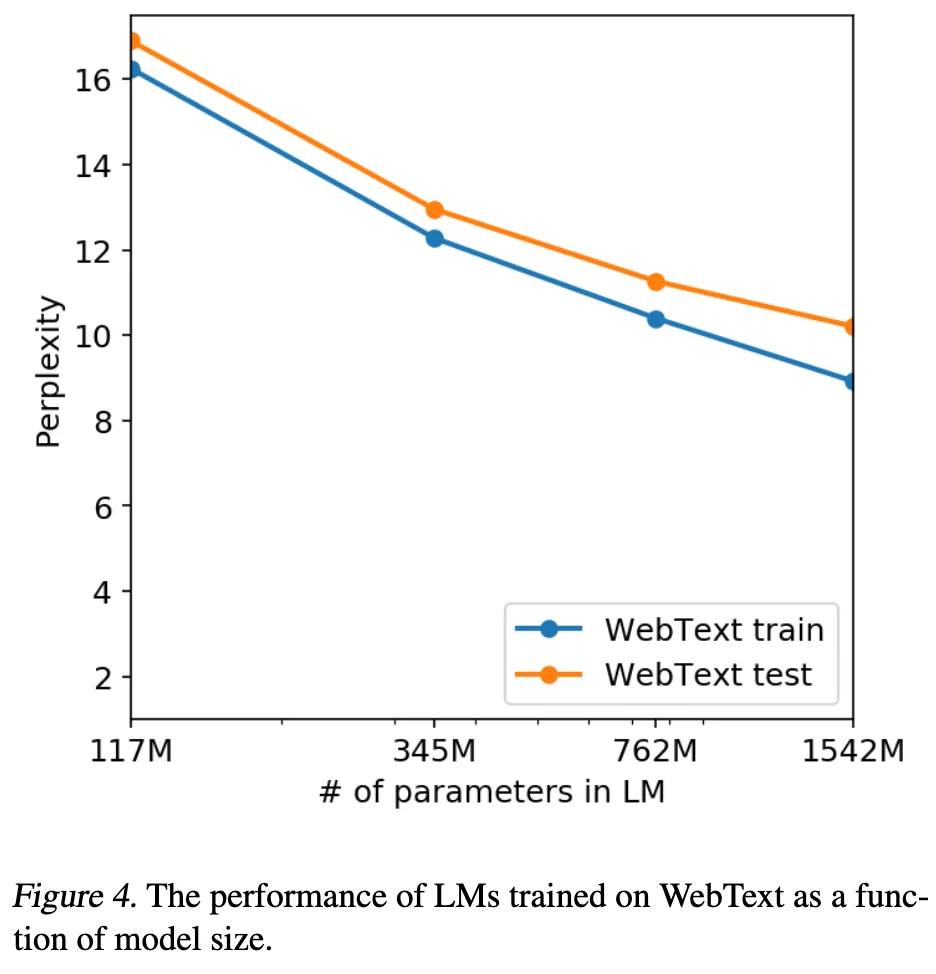
Our largest model, GPT-2, is a 1.5B parrameter Transformer that achieves SOTA results on 7 out of 8 tested language modeling datasets in a zero-shot setting but still underfits WebText.
Generalization vs Memorization
- Quantitative analysis shows that while data overlap provides a minor performance boost, GPT-2’s gains primarily stem from generalization rather than memorization.
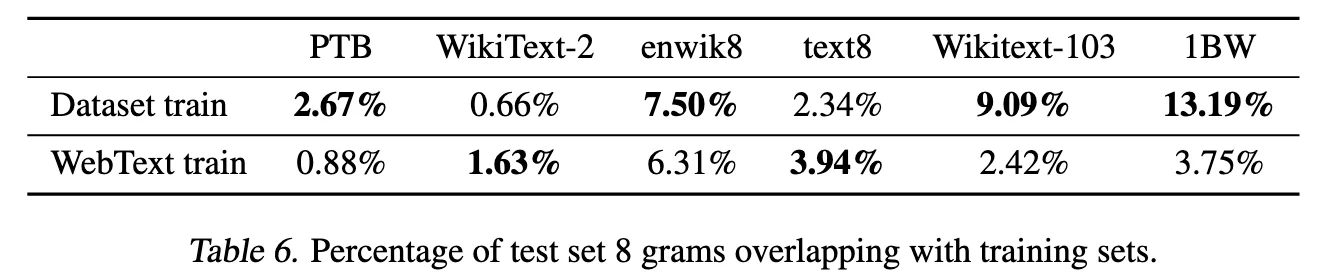
- The model remains underfit on its own training data, suggesting that its emergent capabilities are driven by scale and diversity rather than simple data leakage.
Discussion
GPT-2 demonstrates that massive language models can transition from learning representations to performing tasks directly via zero-shot transfer without explicit supervision.
While achieving SOTA in reading comprehension, its zero-shot performance on complex tasks like summarization remains rudimentary, leaving the ceiling of its fine-tuning potential and architectural efficiency yet to be fully explored.